Wednesday, April 19, 2006
Short stories, poetry, gossip and pictures: piping hot for you
I have a new blog...and I am putting all my short stories online for your reading pleasure in it. It is called A Slice of my life


Thursday, April 06, 2006
Wake up and smell the coffee
The early morning cuppa refreshes and rejuvenates you for the day ahead. The mandatory accompaniment to it is of course the morning newspaper. Most of us still buy a proper printed braodsheet newspapers, while some of us like me have taken to reading it off the net (at least till the time the service is free, at least). So a look at a balmy Thursday morning's headlines, engineered to make your blood boil because of the mismanagement of Public funds on such an immense scale by what we deem to be the goverment.
Bankrupt after 29 years is a story of West Bengal, which spends more than it earns, and fritters away its prosperity (State GDP growth over 7%). While this is the story of West Bengal, even the other "prospersous" states, including Maharashtra, Punjab, Haryana etc. are not far behind in their profligacy. In fact, it is by now common knowledge that if you sell anything to a state government, you might stop hoping to get paid. Consider it to be a donation. (http://businessstandard.com/common/storypage.php?storyflag=y&leftnm=lmnu5&leftindx=5&lselect=1&chklogin=N&autono=220862)
Meanwhile, as the first link maight tell you, the Public Distribution system is in shambles now. A bucket full of holes, where the money you pour in is hijacked by numerous unintended recipients, it is a symbol of the rot that governance in this country has become: a self-perpetuating monstrosity. It is perhaps the acknowledgement of this fact which has made Rang de Basanti (http://www.indiafm.com/movies/review/12493/) to be the hit it is today. Of course it is difficult to agree with the means that those boys took to deal with the problem. But as Pramod Mahajan remarked on an NDTV show, politicians have been killed on screen on flimsier pretexts.
And the poster boy of modern civil engineering in the country, the Delhi Metro? It must surprise most that the system is running at just 20% of the projected capacity...that's almost as bad as the much derided Kolkata Metro. And that was a result of irrationally skewed projections of the traffic that the Delhi Metro was expected to carry...about 21lakh passengers a day, when the DTC buses in the city carry only about 25 lakh people a day! What optimistic ewxuberance made the planners think that they would put the entire existing Public transport system out of reckoning, especially when it is infinitely more convenient over short distances. The Delhi Metro will be roughly 4 times its current size by 2020, but perhaps its time to ponder whether it is worth the investment.
(http://businessstandard.com/common/storypage.php?storyflag=y&leftnm=lmnu5&leftindx=5&lselect=1&chklogin=N&autono=220925)
After all, most metro train systems in the world run at a loss. So is there any point in deliberately bleeding yourself dry?
What is to blame of course is the perverse nature of political decision making which concentrates on earning short term brownie points for immediate electoral gains. (Delhites must remember both Madanlal Khurana and Shiela Dixit rushing in to claim credit at the inauguration of the metro with an eye onthe polls). Town planning requires vision and innovation, both sadly absent from the powers that be in our country.
A knot of tangled hair clogging the drain...Welcome to the undirected, unmanageable, irresponsible urban jungle! Vision 2020!
Bankrupt after 29 years is a story of West Bengal, which spends more than it earns, and fritters away its prosperity (State GDP growth over 7%). While this is the story of West Bengal, even the other "prospersous" states, including Maharashtra, Punjab, Haryana etc. are not far behind in their profligacy. In fact, it is by now common knowledge that if you sell anything to a state government, you might stop hoping to get paid. Consider it to be a donation. (http://businessstandard.com/common/storypage.php?storyflag=y&leftnm=lmnu5&leftindx=5&lselect=1&chklogin=N&autono=220862)
Meanwhile, as the first link maight tell you, the Public Distribution system is in shambles now. A bucket full of holes, where the money you pour in is hijacked by numerous unintended recipients, it is a symbol of the rot that governance in this country has become: a self-perpetuating monstrosity. It is perhaps the acknowledgement of this fact which has made Rang de Basanti (http://www.indiafm.com/movies/review/12493/) to be the hit it is today. Of course it is difficult to agree with the means that those boys took to deal with the problem. But as Pramod Mahajan remarked on an NDTV show, politicians have been killed on screen on flimsier pretexts.
And the poster boy of modern civil engineering in the country, the Delhi Metro? It must surprise most that the system is running at just 20% of the projected capacity...that's almost as bad as the much derided Kolkata Metro. And that was a result of irrationally skewed projections of the traffic that the Delhi Metro was expected to carry...about 21lakh passengers a day, when the DTC buses in the city carry only about 25 lakh people a day! What optimistic ewxuberance made the planners think that they would put the entire existing Public transport system out of reckoning, especially when it is infinitely more convenient over short distances. The Delhi Metro will be roughly 4 times its current size by 2020, but perhaps its time to ponder whether it is worth the investment.
(http://businessstandard.com/common/storypage.php?storyflag=y&leftnm=lmnu5&leftindx=5&lselect=1&chklogin=N&autono=220925)
After all, most metro train systems in the world run at a loss. So is there any point in deliberately bleeding yourself dry?
What is to blame of course is the perverse nature of political decision making which concentrates on earning short term brownie points for immediate electoral gains. (Delhites must remember both Madanlal Khurana and Shiela Dixit rushing in to claim credit at the inauguration of the metro with an eye onthe polls). Town planning requires vision and innovation, both sadly absent from the powers that be in our country.
A knot of tangled hair clogging the drain...Welcome to the undirected, unmanageable, irresponsible urban jungle! Vision 2020!
Rural SEC
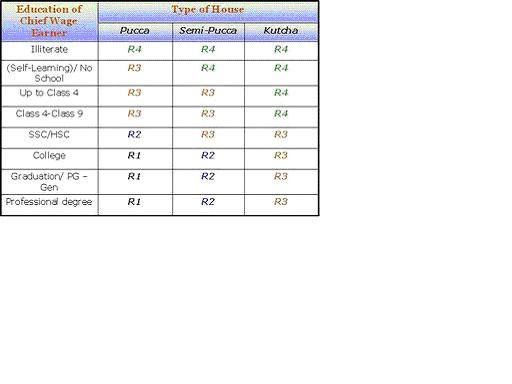
The Rural Market Environment is divided into SEC R1, R2, R3, R4
Calculated as a function of Educational Qualifications of the Chief Wage Earner and the type of the household he stays in – Pucca, Semi Pucca or Kaccha)
Marketing: SEC Grid Urban
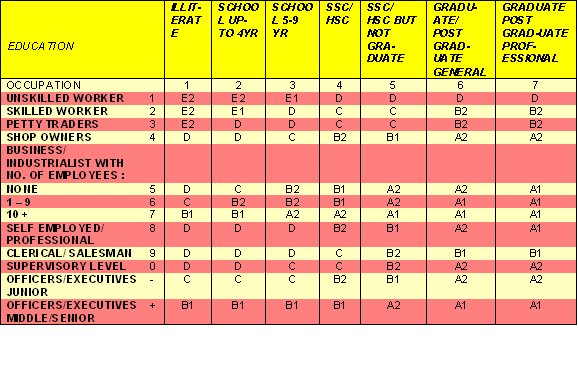
This is the SEC grid as applicable to a urban audience which I am putting up after being requested for it by many friends in Marketing MBA courses around the country. For the Rural counterpart, please refer to the link above (Puru's blog is an unparalleld source for info relating to common marketing issues in our country) or the related post that I will put up shortly.
Some comments to comprehending the Urban SEC grid:
If our Target group is SEC A and SEC B thus includes all of the following:
SKILLED WORKER:
1. GRAD-ATE/ POST GRAD-UATE GENERAL
2. GRADUATE POST GRAD-UATE PROF-ESSIONAL
PETTY TRADERS
1. GRADU-ATE/ POST GRAD-UATE GENERAL
2. GRADUATE POST GRAD-UATE PROF-ESSIONAL
SHOP OWNERS
1. SSC/HSC
2. SSC/HSC BUT NOT GRA-DUATE
3. GRAD-ATE/ POST GRAD-UATE GENERAL
4. GRADUATE POST GRAD-UATE PROF-ESSIONAL
BUSINESS / INDUSTRIALIST WITH NO EMPLOYEES
1. SCHOOL 5-9 YR
2. SSC/HSC
3. SSC/HSC BUT NOT GRA-DUATE
4. GRAD-ATE/ POST GRAD-UATE GENERAL
5. GRADUATE POST GRAD-UATE PROF-ESSIONAL
BUSINESS / INDUSTRIALIST WITH 1-9 EMPLOYEES
1. SCHOOL UP-TO 4YR
2. SCHOOL 5-9 YR
3. SSC/HSC
4. SSC/HSC BUT NOT GRA-DUATE
5. GRAD-ATE/ POST GRAD-UATE GENERAL
6. GRADUATE POST GRAD-UATE PROF-ESSIONAL
BUSINESS / INDUSTRIALIST WITH 10+ EMPLOYEES
1. ILLITERATE
2. SCHOOL UP-TO 4YR
3. SCHOOL 5-9 YR
4. SSC/HSC
5. SSC/HSC BUT NOT GRA-DUATE
6. GRAD-ATE/ POST GRAD-UATE GENERAL
7. GRADUATE POST GRAD-UATE PROF-ESSIONAL
SELF EMPLOYED/ PROFESSIONAL
1. SSC/HSC
2. SSC/HSC BUT NOT GRA-DUATE
3. GRAD-ATE/ POST GRAD-UATE GENERAL
4. GRADUATE POST GRAD-UATE PROF-ESSIONAL
CLERICAL/ SALESMAN
1. SSC/HSC BUT NOT GRA-DUATE
2. GRAD-ATE/ POST GRAD-UATE GENERAL
3. GRADUATE POST GRAD-UATE PROF-ESSIONAL
SUPERVISORY LEVEL
1. SSC/HSC BUT NOT GRA-DUATE
2. GRAD-ATE/ POST GRAD-UATE GENERAL
3. GRADUATE POST GRAD-UATE PROF-ESSIONAL
OFFICERS/EXECUTIVES JUNIOR
1. SSC/HSC
2. SSC/HSC BUT NOT GRA-DUATE
3. GRAD-ATE/ POST GRAD-UATE GENERAL
4. GRADUATE POST GRAD-UATE PROF-ESSIONAL
OFFICERS/EXECUTIVES MIDDLE/SENIOR
1. ILLITERATE
2. SCHOOL UP-TO 4YR
3. SCHOOL 5-9 YR
4. SSC/HSC
5. SSC/HSC BUT NOT GRA-DUATE
6. GRAD-ATE/ POST GRAD-UATE GENERAL
7. GRADUATE POST GRAD-UATE PROF-ESSIONAL
So ILLITERATE OFFICERS/EXECUTIVES MIDDLE/SENIOR or ILLITERATE INDUSTRIALISTS/BUSINESSMEN with 10+ employees will fall in SEC B1
Interesting; and too broad to say the least.
The important thing is to take SEC as a starting point of our search for the target audience…and make sure that we do narrow it down further to give our marketing plans a focus.
Being Cyrus!
Read my review on Mouthshut.com for the movie Being Cyrus.
Talking about movies, this is a preview of THE LAST LEGION: a Hollywood movie starring Aishwarya Rai http://youtube.com/watch?v=MqihhLq5iVg. The best way to watch it would be to let the whole video load(in fits and starts) and then press replay, to watch it seamlessly. Have fun!
Talking about movies, this is a preview of THE LAST LEGION: a Hollywood movie starring Aishwarya Rai http://youtube.com/watch?v=MqihhLq5iVg. The best way to watch it would be to let the whole video load(in fits and starts) and then press replay, to watch it seamlessly. Have fun!
Monday, April 03, 2006
When will India be a common market? GST by 2010?
Time to integrate into a common market, its high time we stopped focussing on carving out separate states from the land. This has been in discussion since the 1950s. Now, its possible due to IT.
The European Union has become an Economic Union with one currency, free mobility of factors of production(men, money and materials. We have a single currency in India ever since our Independence. But what about a common market?
For that to happen there needs to be a single rate of Goods and service tax that is levied on all transactions across the country. As of now we have VAT, but there is a divergence of rates across states, there is octroi or entry tax that delay consignments. There are CENVAT, MODVAT, what not. All this only leads to huge inefficiencies, scope for manipulation and subjectivity.
The result? Why to perpetuate corruption another name for rent seeking, not for any service provided, but to facilitate transactions. Our corporates spend their time not increasing productivity to compete globally, but in battling the capability of the system to destroy productivity.
On the other hand, it affects 'public' services equally. Tonnes of wheat rot away in Punjab and Haryana one year, because the Food Corporation of India finds it too expensive to transport it to states like Orissa where people are starving for want of food. Too many taxes along the route!(The state will tell you that rotting mango kernels are traditional food for the rural populace, but don't for a moment believe them. No one cares for the voiceless downtrodden, and the media attention fades away, inevitably, as another crisis intervenes.)
In the name of National integration...don't just keep singing Vande Mataram. Think economics. Think Common market.
Vote for Higher productivity
Vote for more jobs.
Vote for cheaper goods and services.
Banish shortages.
Banish the ghost of the licence-permit raj.
The European Union has become an Economic Union with one currency, free mobility of factors of production(men, money and materials. We have a single currency in India ever since our Independence. But what about a common market?
For that to happen there needs to be a single rate of Goods and service tax that is levied on all transactions across the country. As of now we have VAT, but there is a divergence of rates across states, there is octroi or entry tax that delay consignments. There are CENVAT, MODVAT, what not. All this only leads to huge inefficiencies, scope for manipulation and subjectivity.
The result? Why to perpetuate corruption another name for rent seeking, not for any service provided, but to facilitate transactions. Our corporates spend their time not increasing productivity to compete globally, but in battling the capability of the system to destroy productivity.
On the other hand, it affects 'public' services equally. Tonnes of wheat rot away in Punjab and Haryana one year, because the Food Corporation of India finds it too expensive to transport it to states like Orissa where people are starving for want of food. Too many taxes along the route!(The state will tell you that rotting mango kernels are traditional food for the rural populace, but don't for a moment believe them. No one cares for the voiceless downtrodden, and the media attention fades away, inevitably, as another crisis intervenes.)
In the name of National integration...don't just keep singing Vande Mataram. Think economics. Think Common market.
Vote for Higher productivity
Vote for more jobs.
Vote for cheaper goods and services.
Banish shortages.
Banish the ghost of the licence-permit raj.
Sunday, December 18, 2005
Electronic Voting Machines cannot deter electoral rigging
This Indian Express reprot reveals the new paradigms of poll rigging. So much for the "Vibrant democracy" of India
What they didn’t want you to see: EC on how Left ‘rigs’ Bengal polls
From using a ‘strong scent’ to mark out voters to planting dummies to slow down voting in Opp bastions: EC observer Amanullah’s report on 2004 polls in Bengal could become a manual for next year’s election
SANTWANA BHATTACHARYA
NEW DELHI, DECEMBER 17: The Election Commission has kept it a top secret—a 10-page report by its Special Observer Afzal Amanullah on what he calls “organised rigging” by “a particular political party” during the 2004 Lok Sabha polls in West Bengal. The reference clearly is to the CPM-led Left Front. Despite a PIL, despite strident demands by the Opposition, the report has never been made public. Not without reason.
To find out why look at:
http://indianexpress.com/full_story.php?content_id=84196
What they didn’t want you to see: EC on how Left ‘rigs’ Bengal polls
From using a ‘strong scent’ to mark out voters to planting dummies to slow down voting in Opp bastions: EC observer Amanullah’s report on 2004 polls in Bengal could become a manual for next year’s election
SANTWANA BHATTACHARYA
NEW DELHI, DECEMBER 17: The Election Commission has kept it a top secret—a 10-page report by its Special Observer Afzal Amanullah on what he calls “organised rigging” by “a particular political party” during the 2004 Lok Sabha polls in West Bengal. The reference clearly is to the CPM-led Left Front. Despite a PIL, despite strident demands by the Opposition, the report has never been made public. Not without reason.
To find out why look at:
http://indianexpress.com/full_story.php?content_id=84196
Fidayeen: A Surprise inside the mind of an "Islamic Terrorist"
Who is a terrorist? Is it a misguided youth with a gun...the angry young man, not knowing what to be angry at? Or is it a man who sells his life for money for the family? Who is a terrorist? More importantly, why is he a terrorist? Can a terrorist be brought back to society. Why do we and our society create such an environment that breeds such discontent that finds recourse in terrorism?
Or is it only another desperate attempt at grabbing power? Is the terrorist then just a dispensable pawn...and religion just an excuse?
A piece from today's Indian Express tries to look into the life of a terrorist:
Fidayeen Muzamil Jaleel goes to meet a would-be suicide bomber. And encounters a scared, almost simple lad who yearns for home and an ordinary life!
http://indianexpress.com/full_story.php?content_id=84163
Or is it only another desperate attempt at grabbing power? Is the terrorist then just a dispensable pawn...and religion just an excuse?
A piece from today's Indian Express tries to look into the life of a terrorist:
Fidayeen Muzamil Jaleel goes to meet a would-be suicide bomber. And encounters a scared, almost simple lad who yearns for home and an ordinary life!
http://indianexpress.com/full_story.php?content_id=84163
Saturday, December 17, 2005
Lawlessness in India
I was always worried by the huge stretches of land that seem totally
devoid of any visibility of the unifying force of the state as I
traveled through countless miles on the Indian Railways. There was an
article a couple of months ago that chalked out the pockets of Maoist
strength in India on a map, and the possibility of a unified effort
derailing the state machinery in a swathe from Nepal (arguably the
stronghold of the Maoists as much as Jaffna is for the LTTE) to Andhra
looked very real, presented that way. Only the Maoists are far from
united. Admittedly, Khushwant Singh is saying nothing new here. But does
serve as a reminder.
What is more worrying is that the state seems incapable of dealing with
them (just look how difficult it was to capture one Veerappan).
Moreover, they have the support of the locals, disillusioned and
disenfranchised as they are, despite over 50 years of democracy. We
never adopted the egalitarian framework of meritocracy. Then, we have
neighbours who are more than willing to fund and stoke cheap insidious
violence. Remember the Purulia arms drop, anyone? Do not ever imagine
that arms have stopped coming in through other routes, and besides there
are country-made weapons and bombs available everywhere. One really does
not need an AK-47 for most purposes of intimidation.
What affects the countryside will not leave the urban pockets of
capitalism on which we are dependent for our livelihood, our dreams and
careers unaffected. We do need political stability for all that. Time
for a paradigm shift , to try and reboot the rural agricultural economy,
to reduce the disparities between town and country as a first step? Who
will bell the cat?
In this context Khushwant shingh writes
India’s Bastille
Khushwant Singh
THE STORMING of Jehanabad jail on the night of November 13 reminded me
of the storming of the Bastille on July 14, 1789, which triggered off
the French Revolution. It is cel- ebrated to this day as Quatorze
Juillet, the French day of Independence. The Ba**stille was stormed by a
Parisian mob. The Jehanabad jail was stormed by hundreds of trained and
armed militants. In the Bastille, they found a handful of prisoners; in
Je- hanabad over 380. No blood was shed in the Bastille; in Jehanabad,
nine men who the attackers regarded as their sworn enemies were slain.
However, let us not take the stor ming of Jehanabad jail lightly. It has
clearly proved that the Naxalite-Maoist inspired peasant movement that
started in Naxalbari in West Bengal in 1967 has steadily gathered
strength. There are pockets of ar med and well-organised guerrilla
fighters stretching from the Himalayas to Andhra and elsewhere. Neither
the police nor the army have been able to stamp it out. Nor can it do so.
Besides robbing landless farmers of their rightful share of produce, the
caste factor has further complicated the issue. The vast majority of
Naxalite-Maoist supporters are drawn from land- less peasantry of the
lower castes. Their prime tar- gets are lan**downers and their cronies
from the higher castes. The latter have their own private militia in
Bihar, the Ranvir Sena, which often slaughters those landless poor who
dare raise their voices in protest against injustice. Successive
governments have done very little to solve their problems. Land reforms
remain largely on paper, as big landowners continue to hold more than is
allowed to them under different names, including that of their ser-
vants. The Bhoodan movement launched by Acharya Vinoba Bhave achieved
very little. There is a lot to be said in favour of the slogan ‘land to
the tiller’. It should be implemented — the sooner the better.
However, modern farming requiring use of tractors, harvesters,
fertilisers, pesticides etc. need huge investments, which small farmers
cannot afford. We have to set up many more farmers cooperatives to get
over these difficulties. If the government does not take up the task
earnestly, pretty soon the Naxalite-Maoist movement may go beyond
control. The storming of Jehanabad jail should not be allowed to become
India’s version of the storming of the Bastille.**
devoid of any visibility of the unifying force of the state as I
traveled through countless miles on the Indian Railways. There was an
article a couple of months ago that chalked out the pockets of Maoist
strength in India on a map, and the possibility of a unified effort
derailing the state machinery in a swathe from Nepal (arguably the
stronghold of the Maoists as much as Jaffna is for the LTTE) to Andhra
looked very real, presented that way. Only the Maoists are far from
united. Admittedly, Khushwant Singh is saying nothing new here. But does
serve as a reminder.
What is more worrying is that the state seems incapable of dealing with
them (just look how difficult it was to capture one Veerappan).
Moreover, they have the support of the locals, disillusioned and
disenfranchised as they are, despite over 50 years of democracy. We
never adopted the egalitarian framework of meritocracy. Then, we have
neighbours who are more than willing to fund and stoke cheap insidious
violence. Remember the Purulia arms drop, anyone? Do not ever imagine
that arms have stopped coming in through other routes, and besides there
are country-made weapons and bombs available everywhere. One really does
not need an AK-47 for most purposes of intimidation.
What affects the countryside will not leave the urban pockets of
capitalism on which we are dependent for our livelihood, our dreams and
careers unaffected. We do need political stability for all that. Time
for a paradigm shift , to try and reboot the rural agricultural economy,
to reduce the disparities between town and country as a first step? Who
will bell the cat?
In this context Khushwant shingh writes
India’s Bastille
Khushwant Singh
THE STORMING of Jehanabad jail on the night of November 13 reminded me
of the storming of the Bastille on July 14, 1789, which triggered off
the French Revolution. It is cel- ebrated to this day as Quatorze
Juillet, the French day of Independence. The Ba**stille was stormed by a
Parisian mob. The Jehanabad jail was stormed by hundreds of trained and
armed militants. In the Bastille, they found a handful of prisoners; in
Je- hanabad over 380. No blood was shed in the Bastille; in Jehanabad,
nine men who the attackers regarded as their sworn enemies were slain.
However, let us not take the stor ming of Jehanabad jail lightly. It has
clearly proved that the Naxalite-Maoist inspired peasant movement that
started in Naxalbari in West Bengal in 1967 has steadily gathered
strength. There are pockets of ar med and well-organised guerrilla
fighters stretching from the Himalayas to Andhra and elsewhere. Neither
the police nor the army have been able to stamp it out. Nor can it do so.
Besides robbing landless farmers of their rightful share of produce, the
caste factor has further complicated the issue. The vast majority of
Naxalite-Maoist supporters are drawn from land- less peasantry of the
lower castes. Their prime tar- gets are lan**downers and their cronies
from the higher castes. The latter have their own private militia in
Bihar, the Ranvir Sena, which often slaughters those landless poor who
dare raise their voices in protest against injustice. Successive
governments have done very little to solve their problems. Land reforms
remain largely on paper, as big landowners continue to hold more than is
allowed to them under different names, including that of their ser-
vants. The Bhoodan movement launched by Acharya Vinoba Bhave achieved
very little. There is a lot to be said in favour of the slogan ‘land to
the tiller’. It should be implemented — the sooner the better.
However, modern farming requiring use of tractors, harvesters,
fertilisers, pesticides etc. need huge investments, which small farmers
cannot afford. We have to set up many more farmers cooperatives to get
over these difficulties. If the government does not take up the task
earnestly, pretty soon the Naxalite-Maoist movement may go beyond
control. The storming of Jehanabad jail should not be allowed to become
India’s version of the storming of the Bastille.**
Subscribe to:
Posts (Atom)